
Fuzzing
Fuzzing (fuzzy — «curly», «blurred») is a trait inherited by Bengal cats from their wild ancestors — ALC or Asian leopard cats. Of course, little leopards, beginning to perceive the world around them, needed protection in order to survive in the jungle. And what could protect them if not “camouflaging” coloration? Starting at 3–4 weeks, a Bengal kitten goes through the fuzzing period; this makes its fur and markings less contrasting, and this period can last from 3 to 5 months.
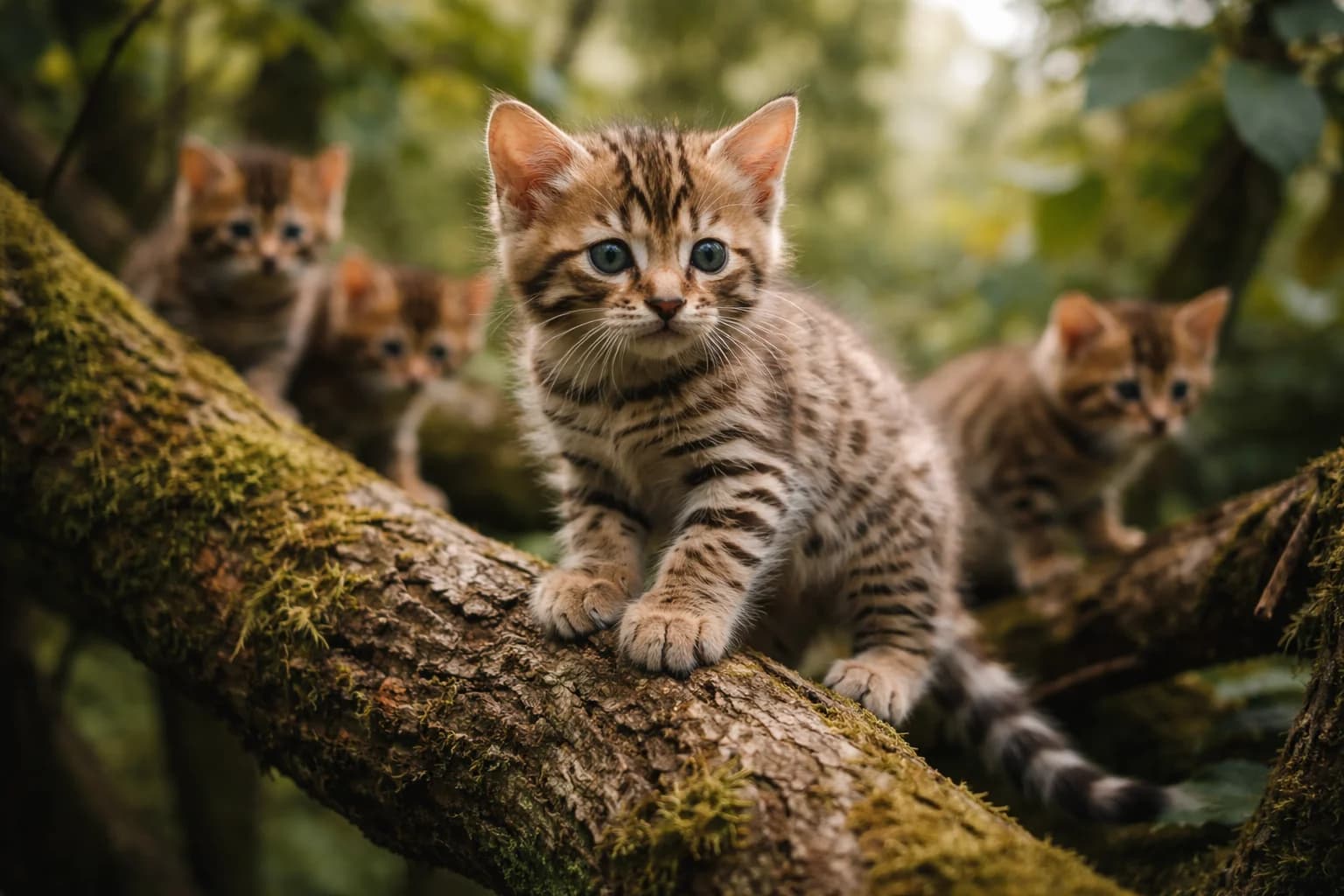
This trait was inherited from the Asian leopard; it happens to hide young leopards from predators. In the picture we see an example of a small fluffy cheetah in the fuzzing stage. Fuzzing is a process that almost all Bengal kittens go through between 1 and 4 months of age, so if you are not familiar with the issue: how to choose a Bengal kitten, it is better to contact the breeder and ask to see photos of the parents. The children will look like them.
A Bengal kitten is finally free of fluff at about 8 months. And sometimes this change ends completely at 1.5 years. Kittens are covered with grayish or whitish pale strands of fur sticking out in different directions. If the fluff is not very strong, the kitten’s pattern looks slightly shaded and blurred. In the case of heavy fluff, it is almost impossible to see the pattern on the coat.
Depending on belonging to a particular breeding line, the fuzzing stage has its own characteristics: in first-generation Bengals F1 and F2, fuzzing is longer. In lines of Bengal cats bred with a mix of American Shorthair, Siamese, Burmese, and Abyssinian cats, fluff is almost absent. Kittens with glitter go through fluffing faster than their brothers and sisters whose coats do not glitter.
Rarely, in Bengal kittens fuzzing begins immediately at birth; the beauty of their color is difficult to distinguish, and it is determined only by the undercoat, but these kittens leave this stage earlier than those who entered fuzzing at the age of 1–1.5 months.